

Description
- Equipped with HDTV imaging capability of high resolution to ensure the best possible image quality for endoscopy and laparoscopy.
- Compatible with EVIS EVIS 100/130/40 and EXERATM 160 Series models as well as bronchoscopes and surgical endoscopes
- Narrow Band ImagingTM (NBI) to improve visibility of fine and mucosal tissues in the gastrointestinal tract.
- There are two types of improvement of the structure: the original type A for observing larger mucosal tissues with high contrast and the new B type for the observation of smaller tissues such as capillaries.
- Electronic magnification magnifies images moving or still with the touch of a button by 1.2x or 1.5x without loss of quality.
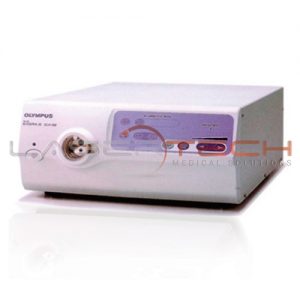
Processor specifications Olympus Evis CV-180
Dimensions
- Tamaño: 370 (W) x 91 (H) x 462 (D) mm
- Weight: 10.5kg
Power
- Voltage (voltage fluctuation): 100 ~ 120V AC 220 ~ 240 (within +/- 1%)
- Frequency (frequency fluctuation): 50/60 Hz (within +/- 1%)
- Power consumption: 150 VA
- Fusible: 5A, 250V
- Fuse size: 5, 20mm
Iris
- Auto iris modes can be selected using the switch “iris mode” on the front panel. Pico: to use when observing by focusing on a small bright area. Auto: to use notes when focusing on the center of the image.
Media
- XD-Picture Card (512/256/128/64/32/16 MB) specified by Olympus. MAPC-10 can be used as PC card adapter.
Recording Format
- TIFF: uncompressed, SHQ: approx. 1/3 HQ: approx. 1/5 SQ: approx. 1/10.
Number of images Recording
- 16MB, NTSC / PAL, TIFF: approx. 17/14 images, SHQ: approx. 80/60 images, HQ: approx. 200/150 images, SQ: approx. ** / ** images.
HDTV signal output
- You can select the output RGB or YPbPr
SDTV signal output
- VBS composite (NTSC / PAL), Y / C and RGB; Simultaneous output possible.
Adjusting the white balance
- Automatic white balance adjustment is possible using the white balance switch on the front panel.
Standard output color chart
- You can display a color bar graph by pressing the “Shift” + “F7” keys “arrow” on the keyboard.
Automatic Gain Control (AGC)
- Image is electrically amplified when light is inadequate because the distal end of the endoscope is too far from the object.


Reviews
There are no reviews yet.